
Showing posts with label film reviews. Show all posts
Showing posts with label film reviews. Show all posts
Wednesday, 20 February 2013

Saturday, 16 February 2013
Friday, 8 February 2013
Saturday, 19 January 2013
Friday, 11 January 2013
Sunday, 16 December 2012
Sunday, 9 December 2012
Thursday, 25 October 2012
Barbarella
Barbarella Review (1968)

figure 1: the poster
From the beginning of the film, Barberella shows clearly not only that it is a product of its time, but aimed firmly at a male audience. Based off of the French Comic strip by Jean-Claude Forest, the film has a very playful ’60’s feel about it. It was released during an age of ‘free love’, where sexual freedom was embraced. This is a film which appears on one hand to be campy, colourful and innocent; however the amount of sexual situations Barbarella (played by Jane Fonda) is put in, makes the film feel unbalanced. It verges on making some scenes feel uncomfortable, simply down to the fact that the target audience is so clearly male, leaving nothing but colours and cute imagery for a female audience. An example would be the opening scene; Barbarella slowly undresses as the credits roll.
However, there is still something charming about the character of Barbarella. She seems to channel some of Elizabeth Montgomery’s (T.V show Bewitched) mannerisms; particularly that of always being polite, no matter what situation she is in.

figure 2: Barbarella
The visuals in Barbarella however, are creative and quirky. It has a cheap, makeshift feel throughout, which fits the tone perfectly. "My then husband, Roger Vadim, came up with all these ideas for how to create special effects and no one had ever done it before, so it's kind of fun." (Fonda, 2011)
Many scenes succeed in creating tension, whilst at the same time, keeping the humor intact. Most notably the doll scene during the beginning of the film; although it is in reality a goofy scene, the scene still offers suspense and at the same time, its humor.

figure 3: flesh eating dolls
The humor in the movie can fall flat, since the jokes are mainly sexual, leaving not much variety, and becoming boring. "Throughout the movie, there is the assumption that just mentioning a thing (sex, politics, religion) makes it funny and that mentioning it in some offensive context....makes it funnier." (Adler, 1968)
Today, the star Jane Fonda believes that the film is "a charming camp movie, not very sexy."(Fonda, 2011)
Barbarella is filmly a product of its time, which dates the film greatly. It is a film which could be described as marmite; it is either loved, or its hated.
sources:
RENATA ADLER http://movies.nytimes.com/movie/review?res=9A01E1DA1530E034BC4A52DFB6678383679EDE&partner=Rotten%20Tomatoes (accessed
Jane Fonda http://transcripts.cnn.com/TRANSCRIPTS/1112/10/pmt.01.html
images:
figure 1: http://upload.wikimedia.org/wikipedia/en/thumb/6/61/Barbarella-poster.jpg/215px-Barbarella-poster.jpg
figrure 2: http://www.gavinrothery.com/storage/barbarella_movie_image_jane_fonda__7_.jpg?__SQUARESPACE_CACHEVERSION=1323719762579
figure 3 :http://tikiloungetalk.com/wp-content/uploads/2009/11/barbarella-dolls.jpg
Alien Review
ALIEN REVIEW

figure 1: a discovery
When looking at the synopsis alone, alien comes across as nothing more than an alien version of ‘The Creature from the Black Lagoon’. However, many things about the film set it apart from others of its genre. A fleshed out story and mythos, acting and unique art design - with artist H R Giger providing set and creature designs based off of his grotesque style artwork, are some of what makes Alien a memorable and influential film.
‘In space, no one can hear you scream’
The plot of Alien is simple: Set in the not too distant future, a small crew of a cargo spaceship receive a warning message from a nearby planet. During their investigation, the resident alien life form gets on-board their ship. when the crew leave, they are unwittingly trapped with it on board their own ship. With the exception of Ripley, the main protagonist, the crew are then killed off in a typical slasher-movie fashion.
What we are treated to along the way, is an investigation into a strange new planet with its “with the organic innards of the derelict ship and its ghostly egg chambers” (newman 2011) designed by HR Giger , and like the crew, confined on board the spaceship, tensely waiting for the next victim to become the aliens next dinner.
I feel The actors, led by the strong female character of Ellen Ripley (Sigorney Weaver) react realistically to what happens to them and this helps make the film experience very dramatic and suspenseful. For example, the scene around the dinner table, John hurt’s character begins to experience symptoms prior to the scene when the alien famously bursts through his chest . in this scene the remaining crew are shown discussing what to do when they assume he is having a fit. they talk over one another as people do in a panic situation, and then decide the should try to stop him from swallowing his tongue. When the alien does burst through his chest, apart from the words 'oh god’, the crew just stands in stunned silence. Screaming is rare in this movie. I think the camera work in the film also helps to create this sense of naturalism by resting on one single shot to let the actors simply have a conversation.

figure 2: Ellen Ripley, the lead
The careful pacing of the film is helped by the limited visual presence of a single entity.
the film keeps the audience enticed by limiting the amount of exposure we have with the , which main reptilian alien form, which Hoffman described “an acid-bleeding, razor-toothed, overgrown cockroach with an ugly practice of gestating its offspring in human hosts.” (Hochman, 1998)
We see the alien species through its life cycle of forms, beginning with the eggs while on the planet, the ‘facehugger’, and finally, the fully developed alien form.
According to Roger Ebert, "Because it doesn't play by any rules of appearance or behavior, it [the alien] becomes an amorphous menace, haunting the ship with the specter of shape-shifting evil".(Ebert 2003)
“Perfect organism. It’s structural perfection is matched only by its hostility”

figure 3: The Alien
In scenes requiring the alien to be played by an actor, 6’10 Nigerian actor Bolaji Badejo was chosen to play the part. Test footage for the movement of the alien shows a single camera shot as Badejo moves around the space. It would have been good to see more shots like that in the film, however this would take away from the mystery of what the alien looks like: up until the last scene in the film, the alien could be any size, any height, and is always kept in the shadows, which is what makes this monster so frightening.
Despite being released in 1979, making it 33 years old, the films use of strong characters (especially a strong female lead), creative practical effects and an engaging storyline, Alien has remained to this day to be one of the top horror films made to date.
Sources
David Hochman http://www.hrgiger-webstore.com/ (accessed 25/10/2012)
Roger Ebert http://rogerebert.suntimes.com/apps/pbcs.dll/article?AID=/20031026/REVIEWS08/310260301/1023 (accessed 25/10/2012)
Kim Newman
http://www.empireonline.com/reviews/ReviewComplete.asp?FID=9531 (accessed 25/10/2012)
images:


Monday, 22 October 2012
Cinematic Spaces: King Kong Review
King Kong Film Review

Figure 1: the movie poster
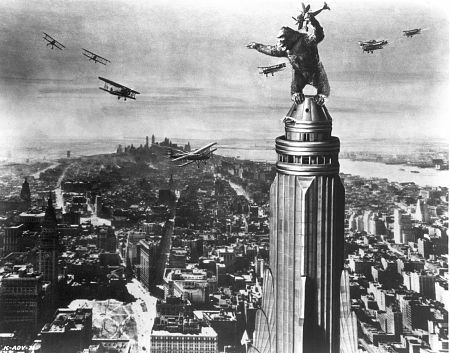
King kong (1933) is a Monster movie, with a twist: A love story, between a woman and giant, god-like ape. The film explores the idea of seeing a giant, destructive monster, and realizing that it is simply an animal, with instincts many of which are animalistic, but many also human.
“Oh no, it wasn't the airplanes. It was beauty killed the beast.”
The film was directed by Meridan C Cooper, and Ernest B Schoedsak; who also developed the original concept.
What Kong has contributed most to the film world, is not the groundbreaking effects. The idea was greenlighted based on a test sequence showcasing animator Willis H. O’Brien’s stop-motion models.1
“Ladies and gentlemen, look at Kong, the Eighth Wonder of the World.”
The special effects team worked hard to come up with creative ways to make Kong seem to be a real creature before us. Stop motion models were used, green screen effects were used, sometimes giant Kong puppets were built.
Most likely down to the stop motion animation, in some animated shots, Kong appears to move in a very animalistic way; the focus can to be on the creatures’ movements and mannerisms, rather than focusing on creating realistic and flowing motion. Scenes such as the dinosaurs attempting to grab their prey in trees, and under logs, are good examples of this. We can see them acting as an animal would; with no emotion behind them. "A curiously touching fable in which the beast is seen, not as a monster of destruction, but as a creature that in its own way wants to do the right thing. "(Ebert, 2002)
However, since O’Brien had the task of making Kong able to have humanistic characteristics, the realistic animal illusion was sometimes lost. "For example, in King Kong, Kong walks more like a man than a gorilla, and his facial expressions are far beyond what is “normal” for a gorilla." (Pullins, 2003)

Figure 2: A dinosaur hunts its prey
“Don't be alarmed, ladies and gentlemen. Those chains are made of chrome steel.”
Kong’s original cut included many scenes seen as too violent to be included. Such scenes included one in which Kong shakes the sailors off of a log and into a deadly giant spider pit. This scene has only been seen once by the public, and has been recreated by Peter Jackson since.1
King Kong has remained a popular Hollywood style monster movie, and has been imitated "in films such as Nabonga, Mighty Joe Young, Congo, and even Jurassic Park"(Pullins, 2003). It has also been adapted numerous times; into an animated film, comic strips, television adaptations, and has even appeared in films alongside Godzilla. The most recent adaptation by Peter Jackson, 2005, has been the closest version to be just as good as the original.
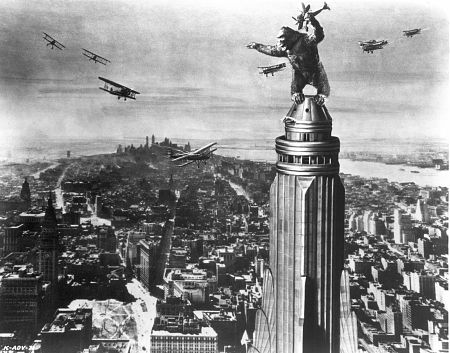
Figure 3: On the empire state building
Sources
Roger Ebert, 2002 http://rogerebert.suntimes.com/apps/pbcs.dll/article?AID=/20020203/REVIEWS08/202030301/1023
Accessed on 22/10/12
Accessed on 22/10/12
Emily E Pullins 2003. http://www.monsterzine.com/200301/kingkong.php
Accessed on 22/10/12
Images


Figure 3
Wednesday, 10 October 2012
Cinematic Spaces: Metropolis
Metropolis

figure 1: The Film Poster
Metropolis is a silent film directed by german expressionist film maker, fritz lang. Made after the first World War, Lang’s science fiction film of shows a pessimistic view of the industrial city of the future. It tells the story of the hero , Freder, son of the master of metropolis, and his beloved Maria, a worker in the underground, and a mad scientist who creates a robot disguised as maria, to control the disgruntle workers who are miniature beginning to rebel against their class.
Using a combination of painted art deco influenced backdrops, miniature sets, mirrors, and innovative costume construction , the film shows to the two spheres of life created by technological progress, : the world above which is healthy, spacious, light, and rich, and the world below, which is dangerous, dark, confined and poor.

figure 2: The workers city
The film’s scenery of the world below the Metropolis shows an ‘underground world of deep shadows” which illuminate the ’expressionist theme of alienation and anxiety’(p227 Eskilson) at the time.
The workers are filmed moving like clockwork parts, with synchronized actions as if they were parts of the machine. There uniformity and downcasts heads reveals to the audience their lack of identity and human soul.
The laboratory space, which is home to the female robot, is a fusion of advanced technological machinery and grandiose gothic architecture which helps to create the image of
A ‘nightmarish place” . (p227 Eskilson)

figure 3: The robot, who will soon appear to be Maria
According to Eskilson, the visual motif of the female robot represents two fears of the german expressionists at that time: fear of machines, and fear of women. In the scene where the robot becomes animated, she gazes directly into the eye of the viewer. Electrical visual effects suggest she is being filled with power and will soon come to life, transformed from a machine into a real human woman, and threaten the lives of the submissive male workers below.
In the tense and anxious scene, when the heroine Maria is being chased through the cavern by the scientist, rotwang, Lang uses darkness and the single light source of the flashlight to take the audience through the terror which she faces.
The Metropolis above ground is created using miniatures of New York style skyscrapers and cathedral like towers. The actors were filmed appearing as if they were amongst the buildings, using an elaborate trick with mirrors called the Schüfftan process.
sources
figure 1:http://upload.wikimedia.org/wikipedia/en/thumb/0/06/Metropolisposter.jpg/220px-Metropolisposter.jpg
figure 2: http://metropolis1927.com/inc/img/gallery/prod/9.jpg
figure 3: http://www.dvdbeaver.com/film3/blu-ray_reviews52/metropolis_blu-ray_/850_metropolis_kino_blu-ray_k1.jpg
http://en.wikipedia.org/wiki/Sch%C3%BCfftan_process
http://en.wikipedia.org/wiki/Metropolis_(film)
Stephen J. Eskilson, 2007. Graphic Design: A New History. Edition. Yale University Press.
Cinematic Spaces: Le Voyage dans la Lune
Le Voyage dans la Lune
Le Voyage dans la Lune (A trip to the Moon) is Georges Méliès' 1902 silent science fiction, fantasy film which he also wrote and directed. There were two versions released at the time; a black and white version, and also a second, hand coloured version.
The film is considered to be the first science fiction film ever made. The film is composed of series of shots which are then combined to form a narrative about the voyageurs of space flight and discovery.

figure 1: One of the environments the travellers come acoss
Each shot tells a short entertaining and fantastical story about a group of astronomers who go on a space ship trip to the moon. Using innovative animation and special effects techniques, Méliès takes the audience on trip around the solar system and the entertaining inhabitants of the moon itself.
Méliès used painted matte backdrops of an artists interpretation of the surface of the moon to create a scense of realism.
Another innovation was his use of split screen double exposure, where the film is run through the camera two times in order to add images together on the same strip.

figure 2: a range of effects were used to create this scene
Méliès also uses models both large and small scale, in order to show the same image at different distances. For example the rocket ship being launched form earth, and the smaller model of the rocket firing into the eye of the moon
This is one of the most renowned scenes in the ten minute film; the landing of the spaceship into the eye of the moon. This shot is an example of how Méliès uses all of his effects; matte backdrops, models, stop motion animation and double exposure to create the special effect.
Sources :
figure 1: http://media.screened.com/uploads/0/2333/198580-snapshot20100518142803_super.jpg
figure 2: http://www.animationmagazine.net/wordpress/wp-content/uploads/melies_trip-to-the-moon_1902.jpg
http://en.wikipedia.org/wiki/Georges_M%C3%A9li%C3%A8s
http://en.wikipedia.org/wiki/A_Trip_to_the_Moon
http://www.wwnorton.com/college/film/movies2/ch/04/essay_sfx.aspx
Cinematic Spaces: The Cabinet of Dr Caligari

figure 1: unique cinematography
The cabinet of Dr Caligari is a german expressionist film, released in 1920 and directed by Robert Wiene. Throughout the film are very unusual yet very individual set designs, which set it apart from other films of its time. The set design of painted canvas showing warped perspectives, slanted roads and “unexpected curves and sudden ups and down” can be seen as a metaphor for what is going through the mind of Francis. The sets became “the elaborate invention of a fantastic world seen through the eyes of a madman” (p.20, Eisner)

figure 2: Influential designs
The Film is known as one of the most inspirational horror movies ever made, influencing many future artists and filmmakers such as Martin Scorsese, who's film 'Shutter Island' pays homage to. "The Cabinet of Dr. Caligari is a film that always bore some similarities in my mind to Shutter Island. It’s a film that Marty admires and one of many he would reference throughout shooting."1

figure 3: Caligari shows off his attraction
The movement of the film is quite varied. At times the pacing is very slow, 'deliberately laborious', perhaps annoying the viewer on purpose. Then the momentum picks up 'when the zig zag motifs of the fairground start turning'. (p.17, eisner).

figure 4: The Ending
The ending is very unique for its time, Ending in a twist. Many horror/suspense films since Caligari have used the same ending, where a world we are seeing on screen is simply in the mind of the character.
"At last I recognize his mania. He believes me to be the mythical Caligari. Astonishing! But I think I know how to cure him now."
Bibliography
1http://www.emanuellevy.com/interview/shutter-island-interview-with-director-scorsese-6/
figure 1: http://silent-volume.blogspot.co.uk/2010/04/cabinet-of-dr-caligari-1920.html
figure 2: http://silentlondon.files.wordpress.com/2011/03/cabinet-of-dr-caligari.jpg
figure 3: http://wondersinthedark.files.wordpress.com/2010/02/cabinet-1-copy.jpg
figure 4: http://filmfanatic.org/reviews/wp-content/uploads/2007/11/codc-ending.jpg
Lotte H. Eisner, 2008. The Haunted Screen: Expressionism in the German Cineman and the Influence of Max Reinhardt. 2nd revised edition.
Subscribe to:
Posts (Atom)